In Korea, Mothers take Myeokguuk or seaweed soup up to 3 times a day after she gives birth. Not just that seaweed helps to promote lactation, they also support hormones and calm the nervous system. On an energetic level, seaweed reminds us that everything is tidal and constantly changing. It invites us too surrender to the waves and let feelings wash over us. Use any kind of seaweed you like and sip the soup straight up. Add with beef, rice and egg to make it a more substantial bowl.
This version of congee requires no translation: It’s oat porridge with a twist. Everyone in the family can enjoy. Oats deliver excellent nutrition and energy and fortify mom’s lactation/ Chia adds an extra protein kiick. To make it extra easy to digest and to cut a few minutes off the cooking time, soak the oats in water for a few hours.
Reduce the heat to medium and let cook. Cover 3/4 of the top of the pot for 10 mins
Reduce heat and simmer for another 15 mins; add more water if needed
Add the chia seeds and condensed milk, stirring occasionally so the seeds separate and incorporate into the mixture. Once the grains are soft and creamy, and most of the liquid are absorbed, remove from heat
When ready to eat, serve warm with milk.
Add Singapore Lactation Bakes's Lactation granola and fresh fruits to add the extra crunch and flavours.
SLB Eating Guide: SLB Eating instruction and Storage Guide
Thank you mummies for having SLB here with you in your marvellous breastfeeding journey! Now that you have the bakes with you, let us SLB eating guide you on how to have the bakes, the SLB eating instructions, how the bakes are suppose to help and things to take note of when you are having our bakes! Feel free to copy and save the above infographic so that you could do reference at any point of time.
How our Lactation cookies works?
Breastfeeding is a natural and nourishing gift for both mums and babies, offering numerous health benefits. However, many new mothers often worry about having insufficient breast milk supply. This can happen for various reasons, especially if you’re not nursing frequently enough.
Milk production follows the principle of supply and demand—the more you breastfeed or pump with proper latch and positioning, the more milk you produce. But for some mums, supply can still be low despite frequent nursing. That’s where galactagogues, like lactation cookies, come into play.
Singapore Lactation Bakes’ (SLB) lactation cookies are crafted with ingredients known to support milk production and help enhance your let-down reflex. To get the most out of SLB bakes, latch or pump immediately when you feel a let-down, as this signals your body to produce more milk.
For example, if you currently pump 5 times a day with 20ml each session, increased let-downs could lead you to pump 7 times a day with an extra 10ml per session, boosting your daily output from 100ml to 120ml. As your supply stabilises, you can slowly reduce the number of cookies while maintaining the improved output.
How long does it takes to see effect?
The SLB Lactation Eating Guide suggests starting with 8-10 lactation cookies and/or 1-2 muffins or brownies daily for optimal results. Some mums may feel fuller breasts or notice more frequent let-downs by the evening, while others might need a few days to see an increase in breast milk supply. Every body responds differently! Some mothers experience a boost within hours, others within 4-5 days, and a few may take 1-2 weeks.
Once your milk supply stabilises, you can gradually taper down your intake.
SLB’s cookies, muffins, and brownies are carefully crafted to support many mothers in boosting their milk supply, while also providing great taste and nutrition. Remember, each mum’s experience with lactation bakes varies, so it’s important to find what works best for you.
Can my family members / friends enjoy the lactation bakes?
Absolutely! SLB lactation bakes contain only whole, honest ingredients with no mystery hormones here. With energy-boosting oats and omega-3-rich flaxseeds, they’re a delicious and nutritious treat for everyone. Whether it’s dad’s gym bag, a toddler’s snack, or a treat for older family members, our bakes are suitable for all ages. Bring on the daddies, kids, and grandparents too!
Who should avoid eating lactation cookies?
Basically anyone in the family can eat the cookies! ( my 3, 5 and 8 year olds are my cookie testers!). However, Lactation bakes are not suitable for pregnant ladies but its ok to start eating them straight after birth.
We also have some Articles on breastfeeding such as how do you know if you are low supply do you have sore nipples or why your baby keeps drinking and well as some Breastfeeding Tips and pumping hacks that you could adopt to make your breastfeeding journey a little easier. Read thru our breastfeeding recipes too as we have compiled some easy recipe for you too! Lastly, Don’t forget to Eat SLB . Breastfeed. Repeat and continue to put baby to breast as often as possible, pump when necessary, stay hydrated and, most importantly, well-rested (yeah, right). Thank you for reading our SLB eating guide. I commend you for even reading this far.
More questions? read our FAQ for more infos or live chat us if you have more questions ya =)
*Our bakes are not intended as a replacement for professional lactation support. Our bakes provide nutritious and valuable lactation support for nursing mothers and their little ones only when used in collaboration with best breastfeeding practices and/or while under the care of lactation professionals.
The way your baby is cared for and nurtured immediately after birth significantly impacts their transition from the womb to life outside. Our modern culture commonly separates mothers and babies for routines procedures like cleaning, weighing and measuring. This leads to babies missing the critical skin-to-skin time with their mothers, which has both short and long term consequences for both of them.
As these procedures are not necessary to maintain or enhance the wellbeing of either mother or baby, there is no reason why they cannot be delayed beyond the first critical hour. The first hour should be focused on the baby’s first breastfeed and mother-baby bonding. Unless the mother or baby requires medical assistance, hospital protocols should support this time of new beginnings for both vaginal and caesarean births.
Personally, I requested for skin-to-skin right after birth and with the newborn checks not executed till much later. I was able to bond with Jo2 and Jo3 for at least an hour before the nurses carried them for their newborn checks.
What Is An Undisturbed First Hour?
Babies are born and immediately placed tummy down on their mother’s stomach. A warm blanket should be placed over both of them to keep the mother warm. This slows the production of adrenaline in her to aid in the production of oxytocin and prolactin; both hormones necessary for bonding and breastfeeding.
At this time, the mother’s needs are simple: warmth and a quiet, calm environment. It is important to remember that she is still in labour — she still has to birth the placenta and membranes, and her uterus needs to contract down.
Here are 6 important reasons why the first hour after birth should be undisturbed:
#1: Baby-Led Initiation of Breastfeeding
These days, it’s quite common for hospital staff to want the baby to begin breastfeeding within the first hour. However, early feeding is important for both the mother and the baby. It’s essential for bonding and helps to expel the placenta quicker and more easily, which reduces the risk of postpartum haemorrhage. It’s common for caregivers to assist the baby to latch onto the nipple, which is unnecessary in most cases. When babies who have not been exposed to medications are placed skin-to-skin with their mothers and left undisturbed, they will instinctually crawl to their mother’s breast and attach themselves to the nipple. This is now known as the ‘breast crawl’ and was first observed by Swedish researchers in the 1980s. Further observation discovered that babies are born with innate instincts that assist them in finding their mother’s nipple, like all newborn mammals. I noticed that with Jo3, it took her about 30 minutes to latch on instinctively, so don’t worry if your baby doesn’t want to latch immediately.
#2: Body System Regulation
Babies who are left skin-to-skin with their mothers for the first hours immediately after birth are better able to regulate their temperature and respiration. Newborns aren’t able to adjust their body temperature as well as older children and adults since they don’t have the same insulating fat levels, after spending 9 months in an environment that is perfectly temperature controlled. If babies lose too much heat, they have to use more energy and oxygen than they can spare to try and keep their temperature stable. An undisturbed first hour with skin-to-skin also reduces the risk of hypoglycaemia (low blood sugar levels). Newborn babies can produce glucose from their body stores of energy until they are breastfeeding well and are more likely to do so when they remain skin-to-skin with their mothers.
#3: Promotes Mother-Baby Attachment
Prolonged skin-to-skin after birth allows mother and baby to get to know each other. Mothers who have skin-to-skin contact after birth are more likely to feel confident and comfortable in meeting their babies’ needs than those who had none. Attachment is critical to newborn survival and mothers are hard-wired to look after their young. The number of oxytocin receptors in a woman’s brain increase during pregnancy. After birth, she is more responsive to the hormone, which promotes maternal behaviour. Oxytocin is produced in large amounts when breastfeeding and during skin-to-skin. Mothers who had early skin-to-skin with their babies are more likely to demonstrate bonding behaviours later in their child’s life, such as kissing, holding, positive speaking and so on. Skin-to-skin is becoming a reality for more c-section mothers and skin-to-skin as you have in the first few days will really promote and help with your breastfeeding journey.
#4: Improves Breastfeeding Success Rates
Breastfeeding is more successful when babies have early skin-to-skin contact. The World Health Organization recommends exclusive breastfeeding for babies in the first six months to achieve optimal growth, development and health. Creating the right conditions for the initiation of breastfeeding would help promote longer durations of breastfeeding for many women. Babies who are left to self attach usually have a better chance of proper tongue positioning when latching. This can increase long term breastfeeding as mothers experience more ease and fewer problems when latching is not an issue.
#5: Protects Against The Effects of Separation
Babies are born ready to interact with their mothers – a newborn baby who has not been exposed to excessive medication will be very alert and gaze intently into their mother’s face, recognising her smell, the sound of her voice and the touch of her skin. Remaining with their mother is key to a baby’s survival and separation can be life-threatening. Babies are born with a mammal’s primal instinct to stay within the safe habitat of their mother, where there is warmth, safety and nourishment. When babies are separated from their mother they will protest loudly, drawing their mother’s attention to their distress. Babies undergo what is literally a cold turkey withdrawal from the sensory stimulation of their mother’s body. If they are not reunited with their mother despite their protests, they will go into a despair state – essentially giving up and becoming quiet and still. This is partly a survival instinct to avoid attracting predators, and their body systems slow down to preserve energy and heat.
#6: Boost Your Baby’s Immunity
Naturally, when babies are born, they emerge from a near-sterile environment in the uterus and are seeded by their mother’s bacteria. This essentially trains the baby’s cells to understand what is ‘good’ and ‘bad’ bacteria. This kickstarts their immune system to fight off infections and protects them from disease in the future. Research indicates that if babies aren’t given this opportunity to be exposed to their mother’s bacteria, their immune system may not reach its full potential, increasing the future risk of disease. If you’ve had a c-section, skin-to-skin and early breastfeeding is needed to increase your baby’s exposure to bacteria.
Here are the 9 stages of the golden hour
Why skin-to-skin is important
Immediate skin-to-skin for a minimum of one hour after birth is one of the most effective methods for promoting exclusive breastfeeding. Babies who have early skin-to-skin are more likely to be exclusively breastfed at discharge, exclusively breastfed after discharge, and breastfed for longer durations. Here are some reasons why it’s important :
Keeps mother and baby together.
Promotes bonding between mother and baby.
Provides for earlier initiation of the first breastfeeding experience.
Reduces crying.
Helps the baby maintain body temperature better than a hospital warmer, as your body will alter your own temperature to warm or cool the baby to maintain a normal temperature.
Helps regulate the baby’s breathing and heart rate.
Help keep the baby’s blood sugar level stable.
Decreases pain for baby from any procedures done while skin-to-skin.
Reduces postpartum haemorrhage in mother.
Can reduce maternal stress and postpartum depression.
Increases the probability of breastfeeding as well as the length of time you will breastfeed your baby beyond the hospital time.
Skin-to-skin right after birth:
Mother is in a slightly reclined position.
The baby is placed on the mother’s abdomen, dried, and covered with a blanket until the cord is clamped.
Once the cord is clamped, the baby is placed chest-to-chest with the mother and remains there uninterrupted for at least one hour and preferably until the first breastfeeding is completed. This provides optimal physiological stability.
The Baby’s face is easily visible and uncovered, the neck is straight, knees are bent.
The baby may be naked or diapered.
Baby can be dried during the process of placing skin-to-skin then baby and mother are covered by a warmed blanket.
Other tests like Apgar scoring can be done while the baby is being held skin-to-skin.
Baby’s measurements can be delayed for up to six hours – they are not going to change dramatically in that time frame.
Time in a warmer will not be needed since the mother’s body will keep the baby warm.
Baby and mother are monitored by nursing staff during skin-to-skin.
Mother notices her baby’s feeding cues, like rooting or sucking on her hands and can guide baby to the breast for first feeding.
skin-to-skin can continue as mother and baby are moved from the labour suite to the postpartum setting with proper observation for safety.
Continued skin-to-skin:
Regardless of the birth setting – hospital, birth centre or home – skin-to-skin can be part of the normal care of the newborn.
The more that mother and baby are together, the easier it is for the mother to recognise the baby’s early feeding cues. More frequently baby will breastfeed, and a greater milk volume will be stimulated.
Mothers who “room-in” in the hospital will tend to practice skin-to-skin more frequently.
Mothers who practise skin-to-skin report greater confidence in their ability to feed and care for their babies.
Babies who “room-in” have more quiet sleep than those who are separated.
Remember that skin-to-skin can continue past the birth period and early postpartum. Many mothers have found that snuggling their baby can be soothing at any time and at any age.
Breastfeeding may be the most natural way to feed your baby, but it can take time and practice for you both to get the hang of it. Understanding how a good breastfeeding latch (also known as breastfeeding attachment) should look and feel can be a huge help in getting feeding established.
There’s no right or wrong way to hold and feed your baby, and each mum and baby will find their own preferred position to feed in. What’s important is that you both feel comfortable. Knowing a few different breastfeeding positions and techniques can be helpful as your baby gets bigger and you start to go out more. Read on to find out how to get a good breastfeeding latch!
A Proper Latch
Before breastfeeding, a mother needs to get into a comfortable position as feeding may take 5 minutes to an hour. Use cushions to support the back to prevent it from getting strained. Not only will it help with the back, but it will also help the baby to latch properly. To start feeding, bring the baby towards the nipple; do not bend towards the baby, as it will result in a poor latch and will hurt in the process.
Holding your breast in a “U” shape will help the baby with good latching. It also makes it easy for the baby to latch on. Keep hands 2 inches away from the nipple. Support the neck of the baby with your hand and gently bring the baby towards the breast.
Aim your nipple towards the upper lip of the baby and not towards the centre. If the baby does not latch on the breast, try rubbing the nipple on its upper lip. This way the baby’s head will tilt back. If the baby does not open its mouth, do not force it in but instead gently rub your breast against its mouth. Squeezing a little milk out and then rubbing will also help the baby open its mouth.
Make sure that the mother and the baby are chest to chest with its nose slightly above the breast. As the baby latches on to the breast, ensure that the nipple and areola (the dark area surrounding the nipple) is in the baby’s mouth. This is considered to be a good latch!
Basic Steps for Latching Positioning
Position yourself comfortably with back support, pillows supporting your arms and in your lap with your feet supported. Whatever feels most comfortable to you!
Position baby close to you with his hips flexed so that he does not have to turn his head to reach your breast. His mouth and nose should be facing your nipple (rather than having to turn his head to face your nipple).
Support your breast if needed so it is not pressing on your baby’s chin. Your baby’s chin should drive into your breast.
Attach or latch your baby onto your breast. Encourage him to open his mouth wide, and pull him close by supporting his back (rather than the back of his head) so that his chin drives into your breast. It helps to tickle his upper lip/nose with your nipple. This will encourage him to open his mouth wide and latch onto your breast. His nose will be touching your breast. Your hand forms a “second neck” for your baby by lightly supporting his neck (not his head).
Enjoy! If you are feeling pain, detach the baby gently and try again.
As you and your baby become more experienced and comfortable with breastfeeding, you’ll find that you can alter your positions in many ways, even from feeding to feeding. As long as you’re comfortable and the baby is nursing successfully, do what works best for you.
How to help your baby latch on the breast
1: Check your latching position.
Position baby close to you
Before you start, and whichever breastfeeding position you choose, make sure your baby’s head, neck and spine are aligned, not twisted. His chin should be up, not dropped towards his chest. Make sure you feel comfortable too – you could use pillows or cushions to support your back, arms or baby.1
2: Encourage your baby to open his mouth
Hold your baby close, your nipple level with his nose. Touch your nipple gently against his upper lip to encourage him to open his mouth wide. The wider his mouth is, the easier it will be to get a good latch on.
3: Bring your baby to your breast
Once your baby has opened his mouth wide and has brought his tongue over his bottom gum, bring him onto your breast, aiming your nipple towards the top of his mouth. Your baby’s chin should be the first thing that touches your breast. He should take a large portion of your areola into his mouth, with his bottom lip and jaw covering more of the underneath of the areola. It’s OK if you see part of your areola isn’t inside his mouth – we all have different-sized areolae and different-sized babies! Some mums find that gently shaping their breast at the same time as bringing their baby on to feed helps. Experiment and see what works.
4: Keep your baby close during latch on
Remember mums all have different breast shapes and nipple positions, so you may not always have that ‘textbook’ latch. Whenever possible, keep your baby close to you, with his chin in contact with your breast. Newborn baby’s noses are turned up so they can breathe easily while attached to the breast. This lets them coordinate sucking and breathing with ease.
5: Look and listen
As your baby feeds, your nipple will be against the roof of his mouth, cupped gently by his tongue underneath. The latch should not feel uncomfortable – it should be more of a tugging sensation. Watch your baby – at first, he’ll do short, rapid sucks to stimulate your milk flow (let-down reflex). Once the milk starts flowing, he’ll suck more slowly and deeply with some pauses, which may indicate he’s taking in milk – a good sign! You should see his jaw moving, and may also hear sucking and swallowing as he feeds. These are all good signs, but it’s also important to check your baby is producing plenty of wet and dirty nappies and gaining weight as expected.
6: How to break your baby’s latch on the breast
If your baby’s latch is shallow or painful, or he starts chomping on your nipple or brushing the end of it with his tongue, remove him from your breast and try again. Ease your clean finger gently inside the corner of his mouth to break his suction if you need to.
How To Confirm If Your Latch Is Good?
Knowing the right breastfeeding latching tips and being aware of common latching signs can make your problems go away in no time. It will make breastfeeding a seamless and hassle-free process. Here are the signs of proper breastfeeding latching amongst babies:
No pain – If the breastfeeding process feels smooth and less painful, then you’ve latched your baby on properly.
Comfortable positioning – Put pillows behind your lower back for added support. If you’re breastfeeding your baby in bed, put some pillows below your knees for cushioning and support.
Nipple inside baby’s mouth – When you’re breastfeeding correctly, the entire nipple should be inside the baby’s mouth
Tummy-to-tummy position – Position your baby in a way that her tummy faces yours during the breastfeeding process.
Head and neck alignment – Make sure the baby’s neck and head align in the same direction so that there’s no discomfort faced when bringing the baby close to your nipple.
Breast support – Support your breast in a way that baby’s chin drives into your breast and not the other way around.
Close positioning – Position your baby close to your nipples so that she doesn’t have to bend or turn her head to reach your breast.
Mouth and nose facing nipple – Your baby’s mouth and nose should face the nipple with the nose touching the breast during the breastfeeding process.
A level head and bottom – Your baby’s head should be at level with the bottom of his body during the breastfeeding process.
Wide mouth – Encourage your baby to open his mouth wide during the breastfeeding process.
The cheeks of the baby will look full, its chin must rest on the breast, and the nose must be free and above the breast. The baby does not make any noise except for swallowing. After the feeding, there will be no change in the shape of the nipple and the baby will look satisfied, any previous irritation disappears, and the baby might even fall asleep.
There will be no movement in the lower jaw of the baby. Instead of an up and down movement, there will be circular movements in the baby’s mouth. With good latching, the baby will be relaxed. If the baby is still restless then the latch is not done properly and will have to be redone.
Some videos to help
Here’s a video on how to get on a good latch for new mothers.
Here’s another awesome video on how to latch!
In conclusion
Remember, breastfeeding should not be painful. A good breastfeeding latch will help keep discomfort to a minimum. If your baby is not latched on well, problems like cracked and sore nipples can develop. Once a good position and latch are established, breastfeeding can be a wonderful, pain-free bonding experience between you and your baby.
If you are still experiencing any nipple pain, dryness or discomfort, try a nipple cream.
If you need further assistance, many hospitals have lactation consultants. Seek to work with a lactation consultant at the hospital or birthing centre in which you delivered. If you are already home, you can speak with your healthcare provider. You can also call a breastfeeding helpline or contact an independent lactation consultant. Join our breastfeeding community to ask fellow mummies for support too!
Last but not least like what Kellymom mentions
No matter what latch and positioning look like, the true measure is in the answers to these two questions:
Is it effective?
Is it comfortable?
Even if the latch and positioning look perfect (yes, even if a lactation consultant told you it was fine), pain (particularly after the first two weeks) and/or ineffective milk transfer indicates that something needs to change, and the first suspect is ineffective latch/positioning.
If the baby is transferring milk and gaining weight well, and mom is not hurting, then latch and positioning are – by definition – good, even if they look nothing like the “textbook” latch.
“Rules and regulations have no place in the mother-baby relationship. Each mother and baby dyad is different and what works well for one mother and baby may not work well for another mother and baby. The important thing to do is to look at the mother and baby as individuals.”– Andrea Eastman, MA, CCE, IBCLC in The Mother-Baby Dance
If anyone deserves a break, it’s a nursing mom! Your desire to have your little one take breast milk from a bottle every now and again so that you can get out of the house and go for a much-needed walk (or at least take a shower or a nap) is completely understandable. But are you worried that your little one won’t take to the bottle easily? Heard one too many “nipple confusion” sagas from friends and lactation specialists? Or has that theory been discounted by your paediatrician and your mother-in-law, leaving you more confused than ever?
What is nipple confusion during breastfeeding?
Nipple confusion is when babies who are used to sucking from bottles have a hard time getting back on the breast. They may have difficulty latching on and may protest the different size or texture. Nipple confusion sometimes occurs in young infants who are breastfed, given both a bottle and a pacifier within a few days of birth. Sucking on a breast, a bottle and a pacifier all require different sucking techniques. Young infants can become confused about which sucking technique to use for which kind of nipple.
A hungry infant who has difficulty sucking becomes quickly frustrated, making feeding your baby difficult and frustrating both for you and your child. While not all young infants suffer from nipple confusion, enough do that it poses a real problem for many new parents.
Is nipple confusion real?
Most babies have no problem switching from breast to bottle and back again. Others, particularly those who take a little longer perfecting the art of suckling at the breast, do find it hard to transition from breast to bottle, and then back to the breast. This is why most experts agree that you should wait until your newborn gets the hang of breastfeeding (about three weeks) before you break out the bottle.
If breastfeeding hasn’t hit its groove by the three-week mark, wait a little longer before introducing the bottle.
Why do you need to hold off before you switch off? If you don’t wait until your baby has perfected her breastfeeding skill, there’s a risk she’ll give up breastfeeding sooner than you’d like.
Does your baby know the difference between breast and bottle?
Newborns catch on pretty quickly they don’t have to work nearly as hard to get milk from a bottle with a rubber (or silicone) nipple as from your breast. To breastfeed, your baby needs to master the fine art of taking your nipple far back into her mouth and then using her tongue to pump out the milk (which can take a minute or so before it starts flowing). With a tilted bottle, a baby has gravity on her side: She can suck with her lips and get all the milk she wants right away. So the baby suffering from nipple confusion may not be befuddled so much as opinionated. She prefers the bottle. And why wouldn’t she? It’s the quicker, easier route to a full belly.
The main reason for developing nipple confusion for bottle-feeding
The main reason for nipple confusion is just simply the fact that bottle feeding for a breastfed baby is completely different from natural breastfeeding. Regardless of what’s in the bottle, it is all about “your breast vs the bottle”, in which your baby has to suck in 2 different ways.
Additionally, the difference in:
Mouth muscles used while sucking from the breast are more than in the baby bottle.
His tongue moving differently in each situation.
The elasticity of breast skin vs the bottle teat.
The milk flow rate from the breast and the baby bottle
Nipple confusion can result at the end of breastfeeding and is a big issue.
Note
Usually, breastfeeding mothers face the nipple confusion issue when they tend to pump/express breastmilk before returning to work or study.
Here are the measures you should take to avoid and fix nipple confusion during mixing between breast and bottle feeding.
When to introduce the bottle
Give breast-only feeding the recommended three weeks for your milk supply to get well established and for your newborn to really master the technique, and then feel free to give yourself that longed-for break.
Tips for introducing the bottle
Some babies take to bottle-feeding right away, others protest. If you’ve got a stubborn bottle feeder on your hands, be ready to offer a choice of formula, nipple sizes and style, and formula-feeding times until he decides which one he prefers. If your baby baulks at breast or bottle, here’s a game plan for handling that nipple confusion (or preference!):
What to do if your baby won’t take a bottle
Go back to square one. Revisit the basics of latching on and remind your baby how soothing breastfeeding can be by cuddling her skin-to-skin. It may require a few sessions of fumbling at the breast before she gets back on track, but it’ll be worth it!
Make it easier. Get your milk flowing (either manually or by pumping your breast milk) before your baby starts to eat, so she doesn’t have to work that hard for the milk. (Just pump enough to get things dripping; you’re not looking to fill a bottle just yet.)
Time it right. She should be in the mood for a meal (aka hungry) so she’s motivated to give it a try…but not so famished that she can’t get her baby brain around relearning an old trick. If she’s starving, she may not have the patience to latch on or suck hard enough to get the milk she wants—and that might lead to a full-blown frenzy of frustration, which can throw both of you off track.
Back off on the faux nipples. If the whole switching process has given your baby a bad case of nipple confusion, just stick with breastfeeding till she’s got it down solid. (This means you’ll need to put away the pacifiers too, just in case she’s gotten too fond of sucking for satisfaction with her lips.)
What to do if your baby prefers breastfeeding
Let Daddy do the feeding. Sometimes a baby is just too attached to Mom’s nipple, so hitting the bottle while Mom is so close by (yet buttoned-up) seems wrong. But it may be a different story if someone else is bringing on the bottle — whether it’s Dad, Grandma, or your best pal. But don’t worry that you’ll always need a Mommy stand-in at feeding time — once your wee one gets the hang of the bottle, she won’t care who gives it to her!
Try different nipples types. If one nipple doesn’t succeed, try, try another one. Just watch the flow rate. The milk should come out fast enough that your baby doesn’t get frustrated…but not so fast that she can’t keep up with the flow. A drop a second when you turn the bottle upside-down is just right.
Make bottle feeding as much like breastfeeding as you can. Interact with your baby. Switch arms halfway through so she has something different to look at. Burp her. But remember that while some newborns want bottle feeding to be just like breastfeeding, others take to it better if the experience is completely different. So if that’s the case with yours, try a different location or even a different position.
To avoid nipple confusion
No bottle introduction or pacifier during the first month
Avoid giving your breastfed baby a pacifier
Start introducing the bottle 3 weeks before work to give him a space to learn the new skill
How to fix nipple confusion?
You can do that by decreasing the gap as much as you can between breast and bottle. The whole idea of how to fix nipple confusion is to mimic the natural process of breastfeeding.
While you try to introduce the artificial nipple, do your best to decrease the difference between the natural nipple of you and the synthetic bottle nipple.
Breastfed baby breast refusal may be due to the type of bottle
The ordinary classic baby bottle has 2 huge disadvantages with regards to nipple confusion:
It is light in weight
It has a narrow/small bottle nipple.
And for that, it is much easier for your breastfed baby to get his milk from the regular bottle rather than your heavy, wide breast. By the time, he would prefer this small/light nipple rather than your breast. So, it is far from your heavy, wide breast nipple.
How to fix that?
Pick a wide base baby bottle that has a wide nipple to mimic the size of your breast. Also, the wide neck bottles are closer to your breast regarding their weight. And remember that your breast is like a heavy sandwich for your breastfed baby to latch on to it.
Nipple confusion makes your baby refusing the breast due to the flow rate
Breast milk ejection from the breast is a time-consuming process. This process is mediated through the lactation hormones, Oxytocin and Prolactin. Your breastfed baby may take around 2 mins to receive the breast milk during natural breastfeeding.
However, the milk comes easily and quickly in the case of bottle-feeding.
How to fix that issue?
Try to choose the slow flow rate teat to make the process slower. On the fast flow bottle nipple teat, it may make it easier for your baby to get choked.
Another way to mimic the slow milk rate of breastfeeding is to apply pauses while bottle-feeding. Don’t let your baby latch on to the bottle for the whole 10 mins of feeding, as gravity makes the milk flow faster from the bottle compared to the breast.
So, what to do instead?
During bottle feeding, you can control the flow by making pauses every 2 minutes for 10 seconds. These pauses will stretch the time needed to finish the milk from the bottle.
By doing that, you mimic breastfeeding sessions’ duration and flow rate. This lets your baby switch between both ways of feeding without feeling a huge difference.
Did your breastfed baby latch onto the bottle properly?
Your baby having a good latch during breastfeeding is crucial for a successful breastfeeding journey. After latching onto your breast deeply, he should do so on the bottle as well. A shallow latch on the bottle is a probable cause of nipple confusion.
What is the solution for a bottle shallow latch?
Simply, ensure that your baby is catching the wide base of the bottle rather than the tip. Like what happens in the normal latching process while breastfeeding, where your baby is catching the most of your areola within his mouth.
How to achieve that?
First, you should stimulate your breastfed newborn for the wide mouth opening. This could be done by raising the bottle at a higher level than his mouth.
Then hit his nose with the tip of the baby bottle tip.
Naturally, he would widen his mouth opening to catch the bottle nipple.
The second step is to pick the widest mouth opening and insert gently and deeply the bottle. You can control this process by grabbing your baby’s head using your hand.
How to balance breastfeeding and bottle-feeding
Bottle or breastfeeding doesn’t have to be an all-or-nothing choice. By spacing out feedings, finding a formula baby likes almost as much as mom’s breast milk, and making sure nursing time includes lots of skin-on-skin bonding, you’ll be able to enjoy the flexibility of both.
sources
What to Expect the First Year, 3rd Edition, Heidi Murkoff and Sharon Mazel.
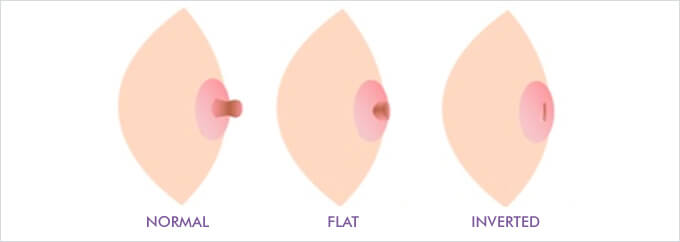
Nipples come in all shapes and sizes and not all nipples point out away from the breast. Some nipples are flat while others are inverted nipples and pull into the breast. Or, nipples may fall somewhere in between.
The amount of fat in your breast, the length of your milk ducts, and the density of connective tissue beneath your nipples all play a role in whether or not your nipples protrude, lie flat, or are inverted.
The shape of your nipples may also change during pregnancy. Sometimes, flat nipples push out during pregnancy and the first week or so after the baby is born.
It’s not uncommon for a woman to worry about breastfeeding with flat nipples. The good news is that with a little extra time and patience, breastfeeding with flat nipples is possible.
Many nipples will stiffen and protrude when stimulated. You can check to see if your nipples are truly flat or inverted. If you’re able to coax your nipples out, then chances are your baby will be able to, too.
Here’s how to check:
Place your thumb and forefinger on the edges of your areola, which is the dark area around your nipple.
Squeeze gently.
Repeat on your other breast.
Different types of nipples
If your nipple is truly flat or inverted, it will flatten or retract into your breast instead of pushing out.
If your nipple protrudes, that’s great. In the case that it does not protrude or become erect, it is considered flat. If it retracts or disappears, it is truly inverted. Nipples that are severely flat or inverted will not respond to stimulation or cold by becoming erect. If you perform the pinch test and your nipples protrude, they aren’t truly inverted and will probably not cause any problems when you nurse your baby.
Testing for flat or truly inverted nipple
A truly inverted nipple is caused by adhesions at the base of the nipple that bind the skin to the underlying tissue. While the skin does become more elastic during the third trimester of pregnancy in preparation for nursing, some of the cells in the nipple and areola may stay attached. Sometimes the stress of vigorous nursing will cause the adhesion to lift rather than stretching or breaking loose, and this can cause cracks in the nipple tissue and pain for the mother.
Because the breasts function independently of each other, it is not unusual for a mother to have one flat or inverted nipple, or to have one nipple that protrudes more than the other. For the same reason, it is not unusual for a mother to produce more milk from one breast than the other.
Another simple way to tell if you have an inverted nipple is that if your nipple protrudes at all—naturally or when stimulated by touch or temperature—you do not have an inverted nipple.
The Hoffman Technique
The most common manual treatment for inverted nipples is the Hoffman Technique, but it’s important to note that studies show conflicting evidence as to whether or not this technique works—and for how long
Here’s how to try it yourself:
Place your thumbs at the base of either side of your nipple and press firmly into your breast tissue.
While pressing down, pull your thumbs away from each other.
Move your thumbs all around the nipple and repeat.
Repeat once per day.
The Hoffman Technique is a manual exercise that may help break adhesions at the base of the nipple that keeps it inverted. Place the thumbs of both hands opposite each other at the base of the nipple and gently but firmly pull the thumbs away from each other. Do this up and down and sideways. Repeat this exercise twice a day at first, then work up to five times a day. You can do this during pregnancy to prepare your nipples, as well as after your baby is born to draw them out.
Hoffman Technique
Is it a deal-breaker if I have an inverted nipple?
An inverted nipple is definitely not a deal-breaker for you!
““Remember that babies BREASTfeed, not NIPPLEfeed” — La Leche League
When breastfeeding, the baby should open up wide enough that he/she takes a good portion of the breast into his/her mouth, bypassing the nipple entirely. Because of this, in most cases, inverted nipples alone will not cause problems with breastfeeding.
When Inverted Nipples May Interfere With Breastfeeding
Inverted nipples can make it more difficult for some women to breastfeed. In rare cases, a mother can experience persistent sore nipples because the baby compresses the buried nipple rather than compressing the milk ducts. The result is little milk for the baby and a painful experience for the mother.
Breastfeeding is more likely to be a challenge for women with inverted nipples based on:
Degree of inversion: If mummy has a slight inversion—the most moderate case—a baby with a normal suck is unlikely to have a problem feeding. If mama has moderate to severe inversion—when the nipple retracts deeply into the areola—baby may have more trouble compressing the milk ducts. The good news is that breastfeeding is usually possible, no matter how inverted the nipples are. Consult an IBCLC lactation consultant for help establishing a proper latch and have patience with yourself and your baby.
Other latching issues: When combined with other latching issues, like tongue tie or lip tie, mama and baby are much more likely to have problems with breastfeeding.
Suction devices
Studies support the use of suction devices—shells, cups, and nipple extractors—for drawing out inverted nipples. They are worn for longer periods of time (over the course of the day, for example), and are meant to loosen the nipple tissue to help nipples stay erect for longer periods of time.
Try an automatic double electric breast pump, which uses uniform suction from the centre of the nipple to draw it out rather than compressing the areola. Over time, the suction usually works to break the adhesions that are holding the nipple in.
A nipple shield—a thin, flexible silicone shield that’s shaped like a nipple and has holes in the tip to allow milk to flow to the baby—can also help. These devices are used during feedings to help draw the nipple out. (Consult a lactation consultant before attempting to use the shield, as it can frustrate the baby and lead to further problems if not used correctly.)
Breast shells are another wearable item that can assist nipple profusion, but unlike the shield, are not used during feeding. Instead, they are worn inside your bra for about an hour before feedings to draw out the nipple.
Other #SLBHacks for Inverted NIpples
Regular nipple stimulation: Before feedings, roll your nipple between your thumb and index finger for 1-2 minutes. Follow up with a damp cold cloth or with ice that has been wrapped in cloth. Keep in mind, you don’t want to ice the nipple to numbness as this can inhibit your let-down reflex.
Manually pulling back breast tissue: As the baby goes to latch, place your thumb on top of your areola and your other four fingers underneath it. Pull the breast tissue towards the chest to help the nipple protrude.
Reverse pressure softening: Before baby latches, place all five fingers around the base of the nipple. Push towards the chest for 1-3 minutes. This may help the nipple protrude and trigger milk flow.
Ensure baby gets a deep latch. When a baby is latching, hold him/her close and align the baby’s nose with your nipple. Pull your breast tissue back, tickle the baby’s lips with your nipple, and wait for the baby to open wide. (
Nipple inversion can make breastfeeding more challenging for some mummies, but it doesn’t make it impossible. If you’re having trouble, give yourself some grace—breastfeeding is hard! If you can get help and stick with it, the benefits are great. But occasionally, breastfeeding becomes too much stress for you or your baby, and it just doesn’t work out.
1. First, mash 1/2 banana in a large bowl. Then add the rest of the wet ingredients and mix until smooth.
2. Add in dry ingredients and mix again.
3. Place in the refrigerator, covered, for at least 2 hours or overnight. Serve cold.
Notes
Feel free to double this recipe.
**It should stay good refrigerated for up to 3-4 days.
**Depending on how thick you like your overnight oats, you may add a splash of almond milk before serving.
Everything you need to know about breastfeeding your newborn, in one article! This article is organised into weeks, to make it easier for new mummies!
The First Week
How often should the baby be nursing?
Frequent nursing encourages a good milk supply and reduces engorgement. Aim for nursing at least 8 – 12 times per day (24 hours). You CAN’T nurse too often–you CAN nurse too little.
Go on-demand feeding. Nurse at the first signs of hunger (stirring, rooting, hands in mouth)–don’t wait until the baby is crying. Allow the baby unlimited time at the breast when sucking actively, then offer the second breast. Some newborns are excessively sleepy at first–wake baby to nurse if 2 hours (during the day) or 4 hours (at night) have passed without nursing.
Is the baby getting enough milk?
Weight gain:Normal newborns may lose up to 7% of birth weight in the first few days. After mom’s milk comes in, if you are breastfeeding your newborn, they should gain about 170 g/week. Take baby for a weight check at the end of the first week or the beginning of the second week. Consult with the baby’s doctor if the baby is not gaining as expected.
Dirty diapers:In the early days, the baby typically has one dirty diaper for each day of life (1 on day one, 2 on day two…). After day 4, stools should be yellow and the baby should have at least 3-4 stools daily that are the size of about2.5 cm or larger. Some babies stool every time they nurse, or even more often–this is normal, too. The normal stool of a breastfed baby is loose (soft to runny) and may be seedy or curdy.
Wet diapers:In the early days, the baby typically has one wet diaper for each day of life (1 on day one, 2 on day two…). Once mom’s milk comes in, expect 5-6+ wet diapers every 24 hours. To feel what a sufficiently wet diaper is like, pour 3 tablespoons (45 mL) of water into a clean diaper. A piece of tissue in a disposable diaper will help you determine if the diaper is wet.
Breast changes
Your milk should start to “come in” (increase in quantity and change from colostrum to mature milk) between days 2 and 5. To minimize engorgement: nurse often, don’t skip feedings (even at night), ensure good latch/positioning, and let your baby finish the first breast before offering the other side.
Call your doctor if your baby has:
no wet or dirty diapers
dark coloured urine after day 3 (should be pale yellow to clear)
dark coloured stools after day 4 (should be mustard yellow, with no meconium)
fewer wet/soiled diapers or nurses less frequently than the goals listed here
or if you have symptoms of mastitis (sore breast with fever, chills, flu-like aching)
Supplement
Get Singapore Lactation Bakes’s Cookies 1-2 weeks in advance and put them in your hospital bag. Skin to skin and latch baby immediately after birth and you may start having the lactation cookies. 10-12 cookies per day promote more letdowns or fuller breasts. Pump or latch baby immediately when you feel the let downs or fuller breast to encourage more milk production.
Weeks Two through Six
How often should the baby be nursing?
Frequent nursing in the early weeks is important for establishing a good milk supply. You should be breastfeeding your newborn 8 – 12+ times per day (24 hours). You CAN’T nurse too often—you CAN nurse too little.
Nurse at the first signs of hunger (stirring, rooting, hands in mouth) and don’t wait until the baby is crying. Allow the baby unlimited time at the breast when sucking actively, then offer the second breast. Some newborns are excessively sleepy, wake the baby to nurse every 2 hours during the day or 4 hours during the night if the baby doesn’t wake up to nurse. Once the baby has established a good weight gain pattern, you can stop waking the baby and nurse on the baby’s cues alone.
The following things are normal:
Frequent and/or long feedings.
Varying nursing patterns from day today.
Cluster nursing (very frequent to constant nursing) for several hours—usually evenings—each day. This may coincide with the normal “fussy time” that most babies have in the early months.
Growth spurts, where baby nurses more often than usual for several days and may act very fussy. Common growth spurt times in the early weeks are the first few days at home, 7 – 10 days, 2 – 3 weeks and 4 – 6 weeks.
Is the baby getting enough milk?
Weight gain:When breastfeeding your newborn, they should gain 6 ounces/week (170 grams/week). Consult with the baby’s doctor and your lactation consultant if the baby is not gaining as expected.
Dirty diapers:Expect 3-4+ stools daily that are the size of about 2.5 cm or larger. Some babies stool every time or even more often when they nurse this is normal. The normal stool of a breastfed baby is yellow and loose (soft to runny) and may be seedy or curdy. After 4 – 6 weeks, some babies stool less frequently, with stools as infrequent as once every 7-10 days. As long as the baby is gaining weight well, this is normal.
Wet diapers:Expect 5-6+ wet diapers every 24 hours. To feel what a sufficiently wet diaper is like, pour 3 tablespoons (45 mL) of water into a clean diaper. A piece of tissue in a disposable diaper will help you determine if the diaper is wet. After 6 weeks, wet diapers may drop to 4-5/day but the amount of urine will increase to 4-6+ tablespoons (60-90+ mL) as the baby’s bladder capacity grows.
Milk supply
Some moms worry about milk supply. As long as the baby is gaining well on mom’s milk alone, then milk supply is good. Between weight checks, a sufficient number of wet and dirty diapers will indicate that baby is getting enough milk.
Boosting Milk supply
Take cookies, muffins, herbs (called ‘galactagogues’) to stimulate the hormones that govern their milk supply. Eat food that boosts milk will help too. You may need to do some trial and error as everyone’s body reacts differently to food.
Reference:
Kelly mom https://kellymom.com/hot-topics/newborn-nursing/