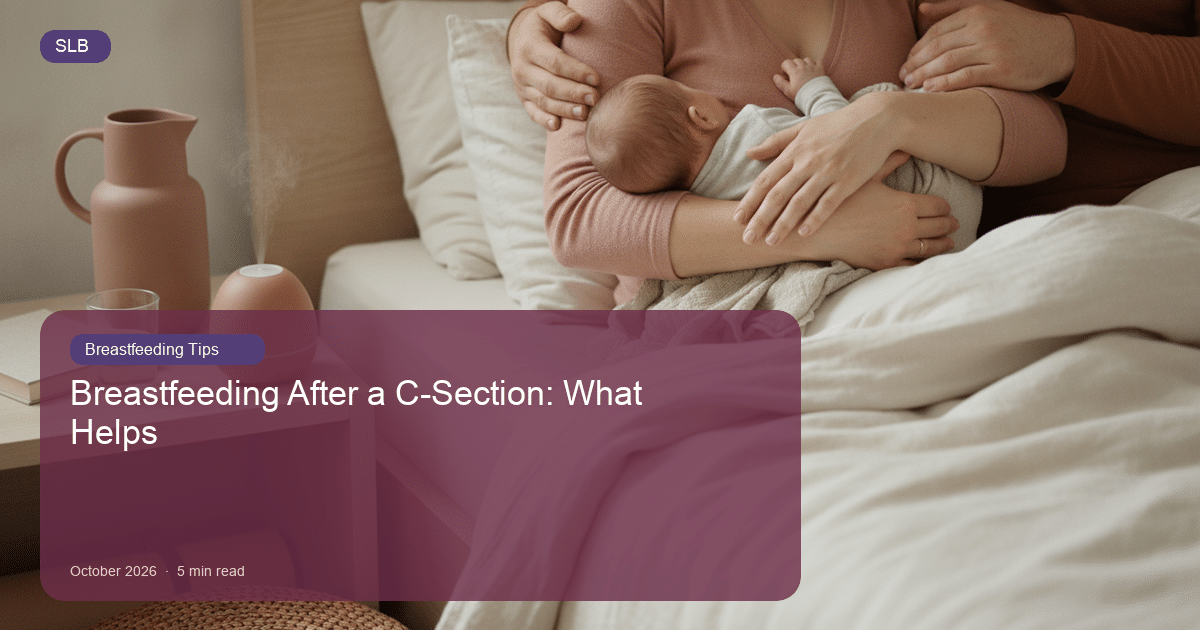
Your Birth Didn’t Go as Planned. Your Breastfeeding Journey Still Can.
Maybe you planned a natural birth and ended up in theatre. Maybe you always knew it would be a caesarean. Either way, you’re holding your baby now, and you’re wondering: will breastfeeding still work for me?
The answer is yes. Breastfeeding after a c-section is absolutely possible. It might look a little different in the first few days, and there may be a few extra things to navigate. But with the right support and a bit of patience, so many mums go on to have beautiful, long breastfeeding journeys after a caesarean.
This guide is written for you. The mum who is sore, tired, maybe a little scared, and just wants honest answers. According to the WHO breastfeeding guidelines, every mother deserves support to breastfeed regardless of how her baby was born. We believe that too.
Why Breastfeeding After a C-Section Can Feel Different at First
During a vaginal birth, your body goes through waves of contractions that trigger a surge of hormones. Oxytocin and prolactin rise sharply, and this helps signal your body to start producing milk. When a c-section happens, especially a planned one before labour begins, that hormonal cascade is different.
This is why many mums find that their milk takes a little longer to come in after a caesarean. Instead of two to three days, it might be three to five days. That is completely normal. It is not a sign that something is wrong with you or your body.
Your colostrum, that thick golden first milk, is still there. It is still exactly what your baby needs. The volume might feel tiny, but it is rich and concentrated and enough for your newborn’s small stomach in those early hours and days.
When Can You Start Breastfeeding After a C-Section?
Sooner than you might think. Many hospitals in Singapore including KKH, NUH, TMC and Mount Alvernia now offer skin-to-skin contact in the operating theatre itself, as long as you and baby are stable. If that was not possible for you, skin-to-skin can happen as soon as you are in the recovery ward.
The anaesthesia used in c-sections, whether spinal or epidural, does not significantly affect your breast milk or your baby. You can nurse as soon as you feel ready. You do not need to wait for the medication to wear off completely.
The goal in those first twenty-four hours is simple. Get baby close. Try to nurse frequently. Eight to twelve times in twenty-four hours is what most lactation experts recommend. Every feed sends a message to your body to make more milk.
The Best Breastfeeding Positions After a C-Section
This is where things get practical. Your incision site is the biggest physical challenge in the first week or two. You need positions that keep pressure off your lower abdomen while still giving baby a good latch.
The Football Hold
This is many c-section mums’ favourite position. You tuck baby under your arm like a football, with their legs pointing behind you. Their body is completely away from your incision. It gives you good control of their head for latching and takes all the weight off your belly. This is worth learning before you leave the hospital.
Side-Lying Position
Lie on your side with baby facing you, tummy to tummy. This is perfect for night feeds because neither of you has to sit up. There is no pressure on your abdomen at all. Many c-section mums use this position throughout their entire recovery month.
Laid-Back or Biological Nurturing Position
Recline back at a comfortable angle, maybe forty-five degrees, with baby lying on your chest or tummy. Gravity does the work of keeping baby in place and there is no weight pressing on your scar. This position also naturally encourages a deeper latch.
What to Avoid Early On
The traditional cradle hold, where baby lies across your lap, places their weight directly over your incision. It tends to be painful and awkward in the first week or two. You can come back to it once your scar is more comfortable.
A firm pillow placed across your lap as a barrier can make any position more manageable. It protects the scar from accidental knocks and gives you a surface to rest your arm on.
C-Section Milk Coming In: What to Expect
Your milk coming in after a c-section might feel slower and more gradual. Your breasts might not feel as full or engorged as you expected. That does not mean your supply is low. For some mums, milk arrives quietly without dramatic engorgement.
Watch baby instead of your breasts. Look for swallowing sounds during feeds, wet nappies increasing from day three or four, and baby seeming settled after nursing. These are the real signs that milk is flowing.
If your milk is taking longer to come in, the most important thing you can do is keep nursing. Frequently and on demand. Each nursing session sends the signal to your body to produce more. Rest as much as you can between feeds. Fatigue genuinely affects milk production. Stay hydrated, especially in the first few days when hospital IV drips and anaesthesia can leave you dry.
Nourishing yourself matters too. Our breastfeeding resources have more on eating well during the early postpartum period.
Nourishing Your Body During Recovery
The confinement month, whether you follow Chinese 坐月子 traditions, Malay berpantang practices, or your own version of rest and recovery, actually lines up beautifully with the time your body needs to establish breastfeeding after a c-section.
Warm, nourishing foods are encouraged across most Singapore confinement traditions. Herbal soups, ginger-based dishes, and wholesome snacks all support your recovery and your milk production.
This is also where lactation-friendly foods can play a gentle role. Oats, flaxseed, brewer’s yeast, and fenugreek are common ingredients known to be supportive during this period. If you are looking for something convenient that requires zero preparation during recovery, SLB lactation bakes are made to nourish and comfort mums exactly at this stage. They are easy to eat one-handed during a night feed, they store well, and many mums keep them in their hospital bag from day one.
There is no need to wait until you are home or fully recovered. You can start from day one post-delivery.
Emotional Recovery Matters Too
If your c-section was not planned, you may be carrying feelings that are complicated and hard to name. Relief that everyone is safe, mixed with grief that things did not go as you hoped. That is real and it deserves space.
Emotional stress after birth, especially birth trauma, can temporarily affect your let-down reflex. Oxytocin, the hormone that releases your milk, is the same hormone that responds to calm and safety. If you are tense or anxious during feeds, it can make the milk flow feel slower.
Gentle breathing, skin-to-skin, a warm drink, soft music, or simply having someone you trust in the room can all help your body relax into the feed. You are not broken. Your body is doing its best in a hard situation.
Navigating Confinement Support at Home
Confinement nannies, mothers-in-law, and family members all want to help. Sometimes that help comes with opinions about how often you should nurse, whether your baby is hungry, or what you should or should not eat.
The most important thing to know is this. Frequent nursing is not spoiling your baby. It is how you build your supply. Eight to twelve feeds in twenty-four hours is evidence-based guidance, not a personal choice you need to defend.
If your helper or family member wants to be involved, they can support you by bringing water, helping you get comfortable before a feed, or handling everything else so you can focus on resting and nursing.
When to Ask for Help
Breastfeeding after a c-section can be straightforward with the right support. But sometimes things are harder than expected and that is when professional help makes a real difference.
Reach out to a lactation consultant if your milk still has not come in by day five or six, if every feed is painful, if baby is not having enough wet nappies, or if you are simply feeling lost and overwhelmed.
Our IBCLC-certified team is here for exactly these moments. An IBCLC can assess your latch, check positioning for your specific recovery needs, and give you a clear picture of how things are going. KKH, NUH, and TMC all have in-house lactation consultants too. You do not need to figure this out alone.
The NHS breastfeeding advice also has clear guidance on when to seek support in the early days.
You Are Not Behind. You Are Just Beginning.
A c-section does not put you at a disadvantage forever. The first few days might be slower. You might need more pillows, more patience, and more people in your corner. But your body knows how to make milk. Your baby knows how to nurse. And every single feed, no matter how small or uncertain it feels right now, is a step forward.
You are not failing. You are figuring it out. And that is exactly what good mothers do.
Frequently Asked Questions
Will my milk definitely come in later because of my c-section?
Not always, but it is common. Milk may take three to five days instead of two to three. Frequent nursing from birth is the best thing you can do to encourage it.
Does anaesthesia affect my breast milk?
Spinal and epidural anaesthesia used in c-sections do not significantly affect your milk or your baby. You can nurse as soon as you feel ready.
Does my c-section scar affect my milk supply long term?
No. The incision site does not affect the glands that produce milk. Once your milk comes in, your supply is governed by how often and how effectively baby nurses.
Can I take lactation supplements after a c-section?
Most lactation foods and bakes made from oats, flaxseed, and brewer’s yeast are gentle and food-based. Always check with your doctor if you have any post-surgical concerns before starting any supplement.
How long before breastfeeding feels normal after a c-section?
Most mums find that by two to three weeks, positioning is less uncomfortable and feeding feels more established. By four to six weeks, many describe breastfeeding as feeling genuinely easier. Every mother’s timeline is her own.