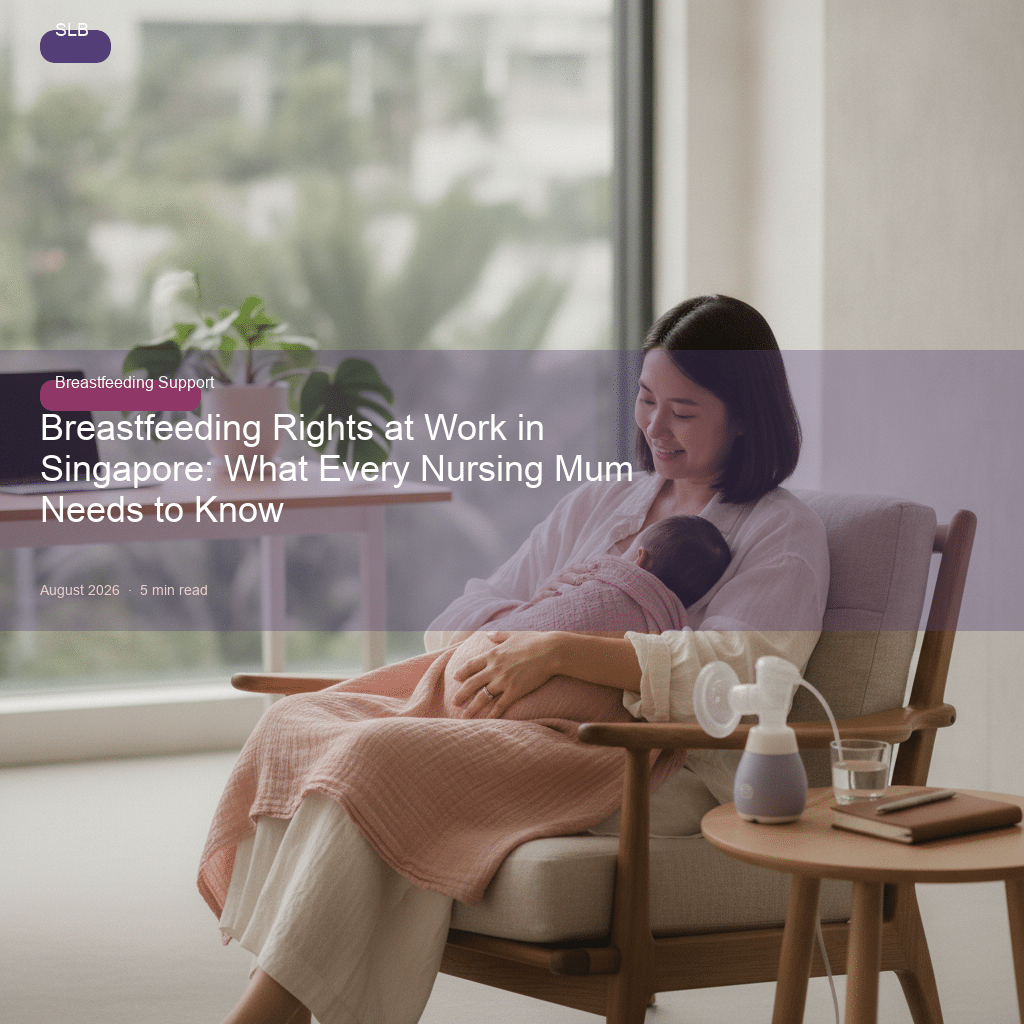
The Honest Truth About Breastfeeding Rights in Singapore
You’ve survived the newborn haze. You’ve found your rhythm with feeding. And now return-to-work is creeping closer on the calendar — and you’re wondering: do I actually have any rights as a breastfeeding mum in Singapore?
Here’s the honest answer. Singapore currently has no specific law requiring employers to provide lactation breaks or a dedicated lactation room. The Employment Act covers your maternity leave entitlements, but once you return to work, breastfeeding continuation is largely left to employer goodwill and your own advocacy.
That’s a hard truth. But it doesn’t mean you’re powerless. Far from it.
Understanding your breastfeeding rights in Singapore — what exists, what doesn’t, and what you can do about it — is one of the most important things you can do before your first day back. And you deserve the full picture, not a sugar-coated version.
What Singapore Law Actually Says (And Doesn’t Say)
Let’s start with maternity leave. If you’re a Singapore citizen employed for at least three months, you’re entitled to 16 weeks of Government-Paid Maternity Leave (GPML). That’s a meaningful stretch of time to establish feeding and bond with your baby.
The challenge is what happens after those 16 weeks end.
When you return to work — often when your baby is between four and six months old and still exclusively breastfeeding — there is no legal entitlement to:
- Scheduled lactation breaks during working hours
- A private, non-toilet space to express milk
- Flexible hours to accommodate feeding schedules
These accommodations exist at your employer’s discretion. Some companies offer them generously. Others don’t offer them at all.
The WHO breastfeeding guidelines recommend exclusive breastfeeding for six months and continued breastfeeding up to two years. The Health Promotion Board echoes this recommendation. But Singapore’s workplace policy has not yet caught up with this guidance in any enforceable way.
What You Can Use: The Flexible Work Arrangements Framework
Here’s where things get more hopeful.
Singapore’s updated Tripartite Guidelines on Flexible Work Arrangements, revised in 2024, now allow employees to formally request flexible working arrangements from their employers. Employers are required to consider these requests fairly and respond in writing.
This matters for nursing mothers. You can formally request:
- Adjusted start or end times to extend morning feeds before leaving home
- Work-from-home days on certain days of the week
- Staggered breaks to allow for expressing sessions
Your employer does not have to say yes. But they do have to consider it properly and give you a written response. That’s a meaningful shift from nothing.
If you work in a larger company — especially a government-linked corporation or a multinational — there’s a reasonable chance they already have internal HR policies supporting nursing mothers. It’s worth asking HR directly, even if nothing is publicly advertised.
How to Advocate for Yourself at Work
Many Singapore mothers feel uncomfortable raising this topic with their managers. Workplace culture here can be hierarchical, and there’s often a quiet worry about being seen as difficult or less committed. That’s completely understandable.
But here’s a reframe that can help. You’re not asking for special treatment. You’re making a reasonable health request that benefits both you and your employer. Mothers who can express regularly during the day are more comfortable, more focused, and less likely to face health complications. That’s good for everyone.
A few practical steps to make the conversation easier:
Have the Conversation Before Your Last Day of Leave
Don’t wait until your first day back to figure this out. Reach out to HR or your direct manager in the final weeks of your maternity leave. Keep it matter-of-fact. Something like: “I’m planning to continue breastfeeding when I return. Can we talk about what’s possible in terms of break time and a private space?”
Ask for Something in Writing
Even an email confirmation of an informal arrangement gives you something to refer back to. It doesn’t need to be a formal contract — just a written note of what was agreed.
Suggest Practical, Low-Cost Solutions
If your workplace has no lactation room, suggest workable alternatives. A lockable meeting room with a booking policy. A privacy screen in a quiet corner. Many employers are more open than you expect once they realise the solution is simple and low-cost.
Use Your Formal FWA Rights
If informal conversations don’t go anywhere, submit a formal Flexible Work Arrangement request under the Tripartite Guidelines. This creates a paper trail and requires your employer to respond meaningfully.
Know Where to Get Support
The Breastfeeding Mothers’ Support Group Singapore (BMSG) at bmsg.org.sg offers peer support, a helpline, and advocacy resources. If you’re facing pushback at work, they can help you navigate next steps. The Association for Breastfeeding Advocacy Singapore (ABAS) is another resource worth knowing.
And if you need professional guidance on managing your supply around a work schedule, our IBCLC-certified team is here to help you build a plan that actually fits your life.
Workplace Lactation Rooms in Singapore: What to Expect
Singapore does have a growing number of lactation rooms in public spaces and larger workplaces, though coverage is uneven.
Major shopping malls, hospitals, and Changi Airport typically have dedicated nursing rooms. The Health Promotion Board has worked with community partners to map public lactation facilities across the island.
In workplaces, the picture varies. Larger organisations — particularly public sector agencies, hospitals, and major MNCs — often have designated lactation rooms as part of employee wellness programmes. Smaller SMEs are less likely to have a formal setup.
If your workplace has no lactation room, here’s the key thing to know: you can request a private, non-toilet space even without a law mandating it. Frame it as a workplace health and hygiene need. Most reasonable employers will find a solution once it’s raised clearly.
Maternity Leave, Breastfeeding, and the Timing Challenge
Singapore’s 16-week GPML is meaningful, but the timing creates a real breastfeeding challenge. Most mothers return to work when their baby is around four to five months old — still fully breastfeeding, before solids have started, and often before supply has fully stabilised.
This is exactly the window where breastfeeding continuation needs the most support. And it’s also the window where, without workplace accommodations, many Singapore mothers end up weaning earlier than they intended.
Return to work is consistently cited as the number one reason Singapore mothers stop breastfeeding before they planned to. That’s not a personal failure — it’s a structural gap.
If you’re navigating this transition, you’re not alone. And there are things you can do in advance to make it more manageable.
Practical Ways to Support Your Breastfeeding Journey When You Return to Work
Preparation makes a real difference. Here’s what helps:
Build Your Freezer Stash Early
In the final weeks of your maternity leave, consider expressing after morning feeds to gradually build a stash of stored milk. This gives you a buffer during the adjustment period.
Work Out Your Expressing Schedule
Aim to express every three to four hours during your working day to keep supply consistent. Factor in your meeting schedule and plan your sessions around it. Speak to your employer in advance about when you’ll step away.
Stay Hydrated and Nourished at Your Desk
A busy workday can make it easy to forget to eat and drink. Keep water at your desk. Have snacks on hand. Nourishing yourself during the day matters for your overall wellbeing during this demanding season.
Our lactation cookies Singapore mums love were made with the working mother in mind — they’re halal-certified, individually portioned, and easy to keep in a desk drawer or work bag for a quick nourishing moment between meetings.
Keep Your Support Network Close
Breastfeeding while working is a team effort. Let the people around you know what you need — whether that’s a partner who handles morning prep, a colleague who covers for you during expressing breaks, or a community of other nursing mums who get it.
For practical guidance on the return-to-work feeding transition, our breastfeeding resources have tips from mothers who’ve been exactly where you are.
Singapore Is Moving — Just Not Fast Enough Yet
There is genuine momentum building around family support policy in Singapore. The 2023 to 2025 period has seen Baby Bonus enhancements, expanded shared parental leave, and a national conversation about making Singapore a better place to raise a family.
Breastfeeding rights at the workplace are a natural part of that conversation. Advocacy groups like BMSG and ABAS continue to push for policy change. And progressive employers — particularly those competing for talent — are increasingly offering lactation support as part of their employee wellness packages.
Change is coming. But in the meantime, you need to navigate the reality as it exists today.
Frequently Asked Questions: Breastfeeding Rights in Singapore
Is my employer legally required to provide a lactation room in Singapore?
No. Singapore currently has no law requiring employers to provide a dedicated lactation room or lactation breaks. However, employers are encouraged under the Tripartite Guidelines to support nursing mothers, and you can formally request flexible work arrangements.
Can I request breastfeeding breaks at work in Singapore?
Yes, you can request them, but your employer is not legally obligated to grant them. Raising the request through formal Flexible Work Arrangement channels gives your employer an obligation to consider and respond in writing.
What if my employer refuses to provide any space or breaks?
Try submitting a formal FWA request first. If that doesn’t work, you can seek guidance from BMSG or the Ministry of Manpower. Documenting your requests in writing is important.
How long should I continue breastfeeding after returning to work?
The WHO breastfeeding guidelines recommend breastfeeding for at least 12 months and continuing for as long as mother and baby wish. Many mothers continue successfully after returning to work with the right planning and support.
What foods support milk supply for working mothers?
Oats, fenugreek, and other traditional galactagogues are commonly used. Staying well-nourished and hydrated during busy workdays matters too. Many Singapore mothers find that having convenient, nourishing snacks on hand — like SLB lactation bakes — helps them stay on track through long work days.
Where can I find lactation room support in Singapore?
The Health Promotion Board has mapped public lactation rooms across Singapore. BMSG at bmsg.org.sg also maintains community resources. For professional support, an IBCLC can help you create a personalised feeding and expressing plan.
You deserve support — at home, at work, and everywhere in between. The legal landscape in Singapore isn’t perfect yet. But you are not alone in this, and you have more options than you might think.