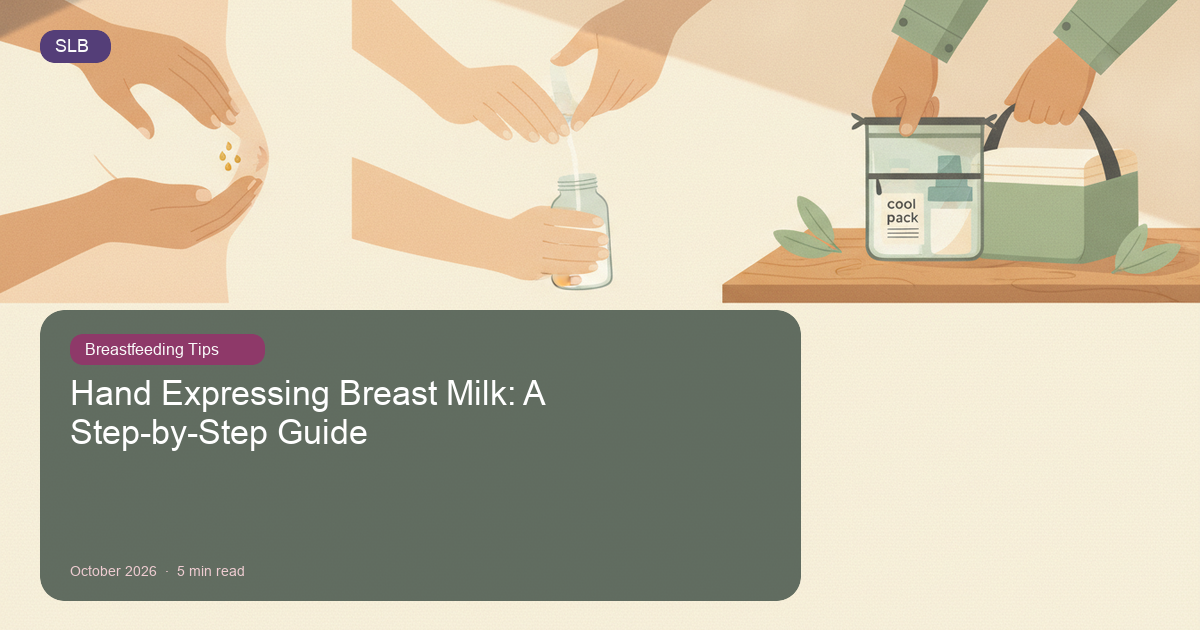
Why Hand Expressing Breast Milk Is Worth Learning
Hand expressing breast milk is one of the most quietly powerful skills you can have as a breastfeeding mum. No equipment. No charging. No sterilising parts at 3am. Just your hands and a clean cup.
Whether you are in the hospital room on day one, sitting in your office nursing room, or navigating confinement at home, knowing how to hand express gives you independence and confidence when it matters most.
It is also especially helpful in the first few days after birth. Colostrum — your baby’s first milk — is thick and comes in very small amounts. A pump often cannot collect it well. Your hands can. Many lactation consultants at KKH, NUH, and Mount Alvernia teach hand expression for exactly this reason.
The WHO breastfeeding guidelines encourage early and frequent milk removal to support your breastfeeding journey, and hand expression is one of the gentlest ways to do that from day one.
If you ever want more personalised support, our IBCLC-certified team is here to help you find your footing.
—
When Should You Hand Express?
There is no single right moment. Hand expression fits into many different situations along your breastfeeding journey.
- In the first 1 to 3 days postpartum — to collect precious colostrum before your milk comes in
- When you feel engorged — a little hand expression softens the breast and makes latching easier for baby
- When you are back at work — especially if you forget your pump or the nursing room has no power point
- During your confinement period (坐月子) — if you have not yet purchased a pump or are waiting for delivery
- When your baby is in NICU or Special Care — hand expressing colostrum in those early hours can make an enormous difference
- To relieve a blocked duct — gentle hand expression can help ease pressure
- To encourage let-down before a pumping session
—
Before You Begin: A Simple Prep Checklist
A few minutes of preparation makes the whole process much more comfortable and effective.
- ✅ Wash your hands thoroughly with soap and water
- ✅ Apply a warm towel or heat pack to your breast for 2 to 3 minutes
- ✅ Gently massage your breast in circular motions from the outer edge toward the nipple
- ✅ Have a clean, wide-mouthed container or sterile cup ready (available at Guardian, Watsons, or Unity)
- ✅ Look at a photo of your baby or have something nearby that smells of them — this genuinely helps trigger let-down
- ✅ Try to be somewhere calm and private — a warm shower also works beautifully
In Singapore’s warm, humid climate, bacterial growth happens faster than in cooler countries. Clean hands and a sterile container are not just good habits — they genuinely matter here.
—
Hand Expressing Breast Milk: Step-by-Step (The Marmet Technique)
The Marmet Technique is the most widely taught hand expression technique in the world. It is taught by lactation consultants across Singapore and is gentle enough to use from day one.
Step 1 — Position Your Hand in a C-Shape
Place your thumb on top of your breast and your index finger underneath, about 2 to 3 centimetres behind the base of your nipple. Your hand should form a soft C-shape. Do not place your fingers right on the nipple or areola.
Step 2 — Press Back Toward Your Chest Wall
Gently press your thumb and finger straight back toward your chest. Do not squeeze or pinch. Think of it as pressing inward, not grabbing.
Step 3 — Compress and Release
Bring your thumb and finger toward each other in a rolling motion — compress, then release. This mimics the way a baby draws milk. Keep the rhythm slow and gentle. Compress, release. Compress, release.
Step 4 — Do Not Slide Your Fingers
Your fingers should stay in the same spot on the skin. Sliding causes friction and skin soreness. The movement comes from the compress-and-release action, not from your fingers moving across the skin.
Step 5 — Rotate Around the Breast
After a few compressions, rotate your hand to a new position around the breast — like moving around a clock face. This helps drain different milk ducts and gives you a more complete expression.
Step 6 — Switch Breasts Every Few Minutes
Move to the other breast when the flow slows. Switching back and forth between sides — two to three times each — helps stimulate more let-downs and increases what you collect overall.
Step 7 — Keep Going for 20 to 30 Minutes
A full session usually takes about 20 to 30 minutes when you are switching between breasts. In the early days of colostrum, a session may feel shorter because the volumes are tiny — and that is completely normal.
—
What to Expect When You Start
Do not worry if nothing comes out in the first minute or two. That is completely normal. You may see a few drops, then a slow drip, and eventually a small stream as your let-down reflex kicks in.
In the first two to three days, you are collecting colostrum. It is thick, golden, and comes in drops rather than streams. Even half a millilitre is valuable. Every drop counts.
Once your milk comes in (usually around day three to five), you may collect more. But output varies enormously between mums, between sessions, and between times of day. Morning sessions often yield more. A slower session does not mean something is wrong.
Please be gentle with yourself. Output during hand expression is not a measure of how much milk your body makes. It is just a snapshot of one moment in one session.
—
Milk Storage Guide for Singapore Temperatures
This is where Singapore-specific guidance really matters. Our year-round heat — averaging 28 to 34°C — means standard Western storage guidelines do not always apply here.
⚠️ Singapore Room Temperature Storage
At Singapore room temperatures (25–30°C), freshly expressed breast milk should be used within 1 to 2 hours. This is shorter than the 4-hour guideline you may see on Western websites, which assume cooler indoor temperatures.
| Storage Location | Duration | Notes |
|---|---|---|
| Room temperature (25–30°C) | 1 to 2 hours | Singapore climate — use or refrigerate quickly |
| Cooler bag with ice packs | Up to 24 hours | Good for commuting or office use |
| Refrigerator (4°C or below) | Up to 4 days | Store at back of fridge, not in door |
| Freezer (minus 18°C) | Up to 6 months | Label with date and time |
Sterile milk storage bags are widely available at Guardian, Watsons, and Unity — pick up a box before you need them.
—
Common Mistakes to Avoid
- ❌ Sliding your fingers across the skin — this causes soreness and bruising
- ❌ Squeezing or pinching the nipple — milk does not come from the nipple tip; it comes from deeper in the breast
- ❌ Placing fingers too close to the nipple — position them 2 to 3cm behind the base of the nipple
- ❌ Pressing too hard — firm but gentle is all you need
- ❌ Giving up after 2 minutes — it takes time for let-down. Stay patient and keep going
- ❌ Expressing in a rush or while stressed — stress genuinely inhibits let-down. Give yourself time
- ❌ Comparing your output to others — every mum is different and every session is different
—
Tips to Help Your Milk Flow
- 🌡️ Apply a warm compress or take a warm shower before you start
- 🤱 Do skin-to-skin with your baby if possible — even just holding them close helps
- 📸 Look at a photo or video of your baby when expressing away from home
- 🎵 Play calming music or a recording of your baby’s sounds
- 💧 Stay hydrated — keep a glass of water nearby during your session
- 🍪 A nourishing snack beforehand can help you feel more settled and comfortable. Many Singapore mums find that having something warm and comforting — like our SLB lactation bakes — before a session makes the whole experience feel a little more nurturing
- 🔄 Alternate breasts every few minutes rather than exhausting one side first
- 🙆 Relax your shoulders and breathe — tension in your upper body affects let-down
—
Frequently Asked Questions About Hand Expressing
Is hand expressing painful?
It should not be. You may feel a little pressure or fullness, especially if your breasts are engorged. If you feel real pain, check your technique — most commonly, fingers are too close to the nipple or sliding on the skin. Adjust and try again gently.
How much milk should I get when hand expressing?
There is no single right answer. In the first few days, a few drops to a few millilitres of colostrum is completely normal and meaningful. Once your milk comes in, output varies widely between mums and between sessions. Please do not use output as a measure of your worth as a breastfeeding mother.
Can I hand express colostrum before my baby is born?
Antenatal expression — hand expressing from around 36 weeks — is something some mums do under guidance from their midwife or lactation consultant, particularly if there is a clinical reason to have colostrum stored. Always check with your healthcare provider first, as it is not recommended for everyone.
How long should one session take?
A full session switching between both breasts typically takes 20 to 30 minutes. In the colostrum stage, it may feel shorter. You will find your own rhythm as you go.
Is hand expression as effective as using a pump?
In the first few days, hand expression is often more effective — especially for collecting thick colostrum. Later on, a pump may be more convenient for some mums, but hand expression remains a valuable skill at every stage. Many mothers use both at different times.
My milk is not coming out — am I doing it wrong?
Not necessarily. It takes a few minutes for let-down to happen. Make sure you have done your warm compress and massage, that you are in a calm space, and that your fingers are positioned correctly. If you consistently struggle, that is a good signal to reach out to a lactation consultant who can watch your technique and offer real-time support.
How do I store milk I hand express at work?
Label your storage bag or cup with the date and time. Pop it in a cooler bag with ice packs for the journey home, then refrigerate or freeze when you arrive. At Singapore room temperatures, do not leave expressed milk unrefrigerated for more than 1 to 2 hours.
—
When to Ask for Help
Hand expressing is a skill, and like all skills, it takes a little practice. But if you are consistently finding it painful, getting nothing after several attempts, or feeling worried about your milk supply, please do not struggle alone.
Singapore has wonderful support available. Lactation consultants are available at all major maternity hospitals, and subsidised support is available at polyclinics. You can also explore our IBCLC-certified team for professional, compassionate guidance.
The NHS breastfeeding advice also has clear guidance on hand expression technique if you want an additional reference to read through.
And for everything else along the way — the nourishment, the encouragement, the community — you will always find that at our breastfeeding resources page too.
You are doing something meaningful. Every drop matters. And you do not have to figure it all out alone. 🤍